



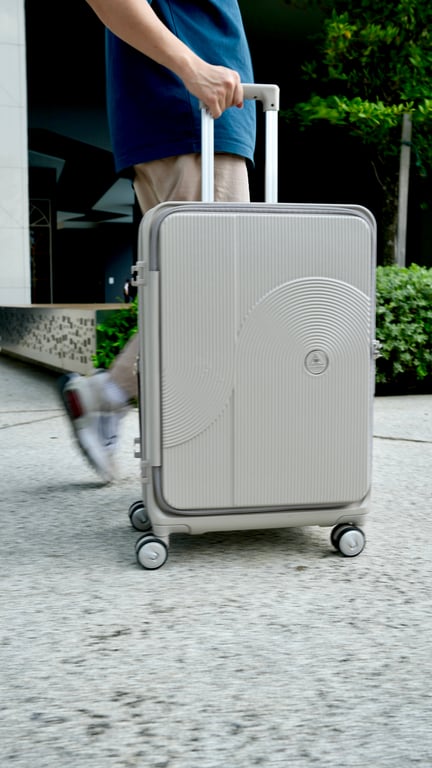
For many years, luggage design has remained largely unchanged. Most suitcases still follow a traditional structure that opens into two equal halves, requiring users to lay the luggage flat to access their belongings.
While this design has been widely accepted, changes in travel behavior are beginning to highlight its limitations.
Changing Travel Patterns
Modern travel has evolved significantly. Travellers today often take shorter trips, move between multiple destinations, and stay in more compact accommodations, particularly in urban cities.
Hotel rooms in destinations such as Tokyo, Seoul, and other major cities are often designed with limited space, making it less practical to fully open a suitcase on the floor. In addition, fast-paced itineraries mean that travellers may not fully unpack during their stay, relying instead on quick and frequent access to their belongings.
These changes have shifted how luggage is used — from a storage solution that is unpacked upon arrival to a more dynamic, frequently accessed travel companion.
Limitations of Traditional Luggage
The conventional clamshell design assumes that travellers have sufficient space and time to fully open and organise their luggage. However, in many real-world situations, this is not the case.
Common challenges include:
• Limited floor space to fully open luggage
• Difficulty accessing specific items without unpacking
• Inconvenience when opening luggage in shared or tight environments
As a result, travelers may find themselves repeatedly opening and closing their luggage or reorganizing items unnecessarily.
Shift Towards More Practical Access
In response to these challenges, luggage design is gradually adapting to better suit modern travel conditions.
One emerging approach is front-opening luggage, which allows access through a vertical opening instead of requiring the suitcase to be fully laid flat. This design enables users to retrieve items more easily in space-constrained environments and reduces the need for full unpacking.
Case Valker’s FrontFlip™ Approach
Case Valker has introduced this concept through its FrontFlip™ system, featured in the EVE2 collection. The design incorporates a structured front-opening panel that allows users to access their belongings without opening the entire suitcase.
This approach is intended to improve usability in situations where space is limited, such as small hotel rooms, transit areas, or shared accommodations.
In addition to the front-opening structure, the EVE2 collection includes features such as multi-directional spinner wheels, secure zipper systems, and expandable storage, supporting different types of travel need
Looking Ahead
As travel continues to evolve, expectations around convenience and practicality are also changing. Luggage is no longer just about storage capacity, but also about how easily travellers can access and manage their belongings throughout a trip.
Design approaches that focus on real-world usage — including accessibility and space efficiency — are likely to become more relevant as travellers seek solutions that better match their travel environments.
For more information, visit www.casevalker.com.
This press release has also been published on VRITIMES