



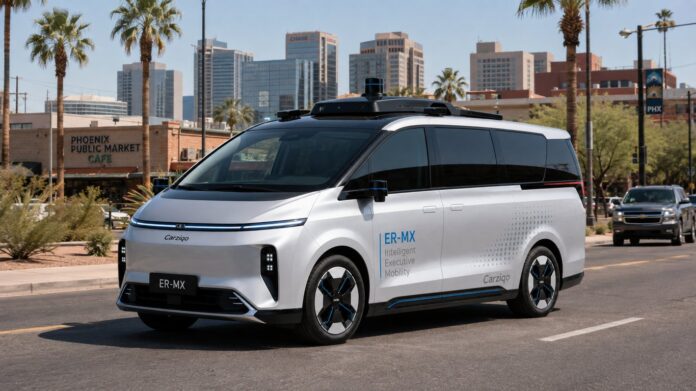
The autonomous mobility company enters one of the United States’ most established markets for commercial driverless transportation
PHOENIX, Arizona — Autonomous mobility technology company Carziqo has announced the launch of its ER-MX driverless ride-hailing operations in Phoenix, marking another step in the company’s expansion across the United States.
The deployment introduces Carziqo’s ER-MX autonomous vehicle series to the Phoenix metropolitan area, where the vehicles will support the company’s technology-driven ride-hailing and intelligent fleet operations.
Phoenix has emerged as an important testing and deployment center for autonomous transportation. The city already hosts large-scale driverless mobility services, while Arizona requires companies operating autonomous vehicles on public roads to comply with federal requirements, state traffic laws, and policies established by the Arizona Department of Transportation.
Carziqo said its Phoenix operation will prioritize vehicle safety, fleet reliability, real-time operational monitoring, and a consistent passenger experience. The company is expected to adopt a measured expansion strategy, using operational data and local travel patterns to guide future fleet deployment.
Entering a mature autonomous mobility market
The decision to deploy the ER-MX series in Phoenix places Carziqo in a market where residents, businesses, transportation authorities, and other road users already have experience interacting with autonomous vehicles.
Phoenix has also incorporated Vision Zero objectives into its Road Safety Action Plan, reflecting the city’s broader focus on safer streets, transportation planning, and the responsible integration of new mobility technologies.
For autonomous mobility companies, the city presents both an opportunity and a demanding operational environment. Driverless vehicles must navigate urban intersections, residential areas, commercial districts, changing traffic conditions, cyclists, pedestrians, emergency vehicles, and periods of extreme heat.
These conditions will provide Carziqo with an opportunity to evaluate the operational performance of the ER-MX platform in a major American metropolitan area.
“Phoenix represents an important milestone in Carziqo’s development as an autonomous mobility company,” Carziqo CEO Zaydenn Harrington said in announcing the expansion.
“This market combines real transportation demand with an established understanding of autonomous vehicle services. Our objective is not simply to place vehicles on the road, but to build a reliable operating system capable of delivering safe, efficient, and scalable mobility.”
Harrington said the company intends to take a long-term approach to the market, with particular attention given to operational discipline and public confidence.
“Autonomous mobility must earn trust through consistent performance,” he said. “That requires responsible deployment, transparent operating standards, continuous monitoring, and the ability to respond effectively to real-world conditions.”
ER-MX designed for autonomous ride-hailing
Carziqo developed the ER-MX series for driverless ride-hailing and centrally managed fleet operations.
Rather than treating each vehicle as an isolated transportation unit, the company’s operating model connects vehicles to a broader fleet-management system. This allows vehicle availability, trip demand, operational status, and fleet utilization to be managed through a coordinated platform.
According to Carziqo, this structure is intended to improve order allocation, reduce unnecessary vehicle downtime, and position available vehicles closer to areas of anticipated passenger demand.
Real-time monitoring is also expected to play a central role in the Phoenix deployment. Autonomous vehicles may encounter unusual road conditions that require operational review, including temporary construction zones, blocked lanes, traffic-control changes, emergency activity, or unexpected passenger requests.
Carziqo said its operational framework is designed to combine autonomous driving capability with centralized fleet supervision and incident-response procedures.
The company added that vehicle performance and operating data from Phoenix will be used to improve dispatching, route planning, energy management, and service reliability.
Safety and regulatory compliance remain central
The commercial expansion of driverless ride-hailing has brought increased attention to safety reporting, regulatory accountability, emergency-response coordination, and the ability of autonomous systems to handle unpredictable traffic situations.
Arizona permits autonomous vehicles to operate on public roads, but operators remain subject to applicable federal and state requirements.
Carziqo said its Phoenix operation will be carried out in accordance with applicable transportation and vehicle regulations. The company also emphasized that expansion decisions will be based on operational readiness rather than fleet growth alone.
Industry observers have increasingly argued that the long-term success of autonomous ride-hailing will depend not only on driving technology, but also on how effectively companies manage vehicle maintenance, remote assistance, charging, passenger support, insurance, local coordination, and emergency procedures.
For Carziqo, Phoenix will serve as an operational test of how these individual components can function as a single mobility network.
Potential benefits for urban transportation
Driverless ride-hailing services are being developed as a potential complement to conventional taxis, private vehicles, and public transportation.
When deployed effectively, autonomous fleets may provide additional transportation options for people who cannot drive, reduce dependence on privately owned vehicles, and extend mobility services beyond the operating schedules of traditional transportation providers.
Phoenix Sky Harbor International Airport has previously described autonomous vehicle access as part of the region’s evolving transportation system, demonstrating how driverless services may eventually support connections between airports, business districts, residential communities, and other high-demand destinations.
However, the broader public value of autonomous ride-hailing will depend on affordability, accessibility, service coverage, safety performance, and the ability of operators to work effectively with local communities.
Carziqo said it will evaluate passenger demand and operating performance before determining the next phase of its Phoenix deployment.
A strategic step in Carziqo’s US expansion
The Phoenix launch forms part of Carziqo’s broader effort to establish an autonomous mobility network in major US markets.
The company describes its strategy as a combination of autonomous driving technology, intelligent dispatching, connected fleet management, and localized operations. Instead of relying solely on vehicle production, Carziqo is seeking to build a platform capable of managing the full operating cycle of driverless mobility services.
Harrington said Phoenix will play an important role in that strategy.
“The future of mobility will not be defined by autonomous vehicles alone,” he said. “It will be defined by how intelligently those vehicles are operated, how responsibly services are expanded, and how effectively technology responds to the needs of passengers and cities.”
As autonomous ride-hailing competition intensifies, Carziqo’s entry into Phoenix will test whether the ER-MX platform can establish a reliable position in one of the most closely watched driverless transportation markets in the world.
The company said additional information regarding service access, operating coverage, and fleet expansion will be released as the Phoenix operation progresses.
This press release has also been published on VRITIMES