



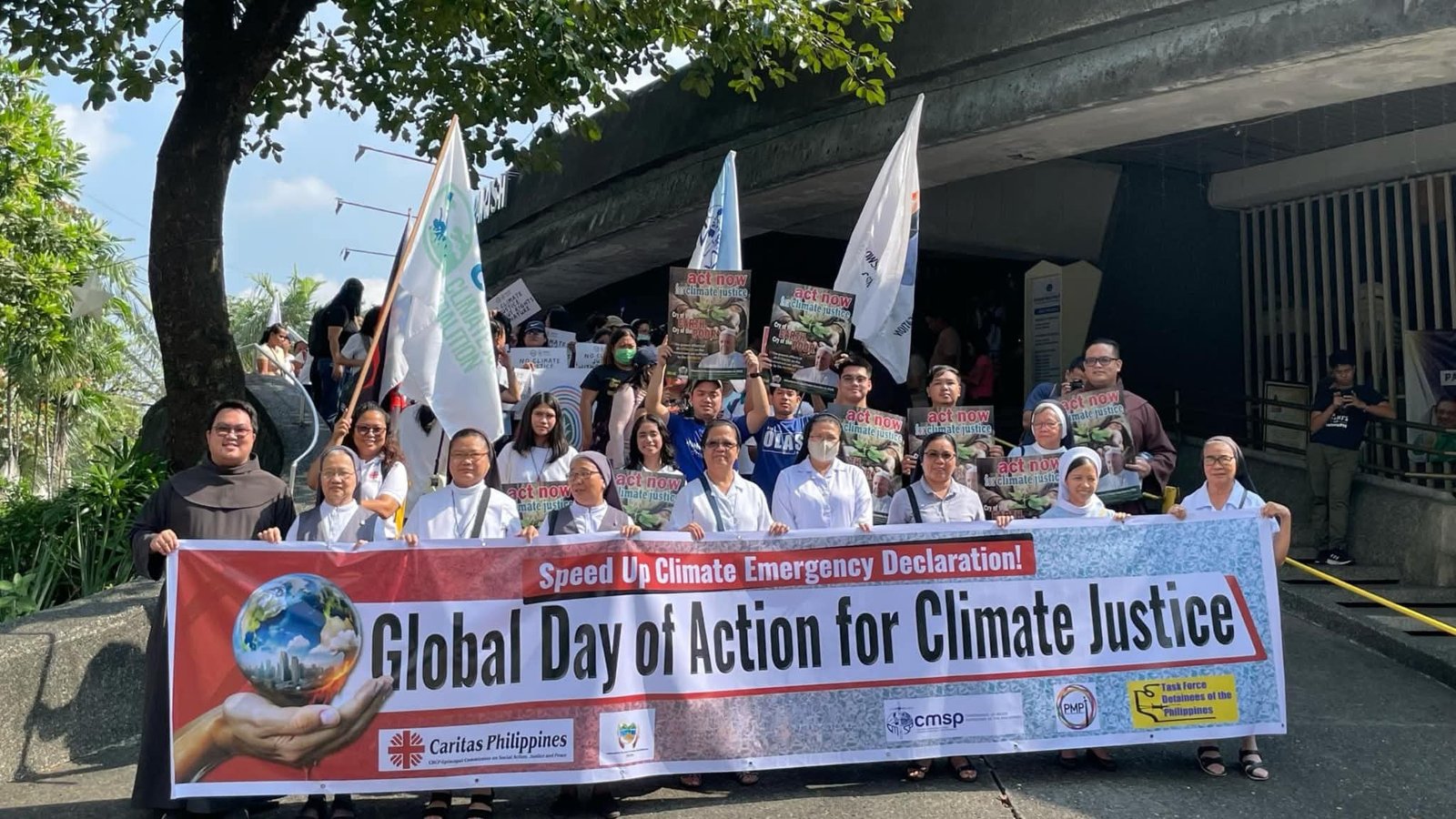
Asian Churches Call for Justice: Philippine Catholic Church Backs Global Push to “Turn Debt into Hope”
At the end of the 47th ASEAN Summit, churches in Asia call on ASEAN member states and international financial institutions to move beyond business-as-usual models that prioritize economic growth and instead to embrace a regional framework for ecological debt relief, to phase out fossil fuel dependency, and to redirect financial flows toward loss-and-damage funds and community-led renewable energy initiatives.
The appeal also comes just weeks ahead of COP30, where nations are expected to strengthen their climate commitments under the Paris Agreement.
The Federation of Asian Bishops’ Conferences (FABC) has sounded a united call: rich nations must pay their ecological debt through fair climate finance—without further indebting the Global South. This demand, rooted in justice, seeks to address the mounting losses and damages in Africa, Asia, Latin America and the Caribbean, and Oceania—regions least responsible for the climate crisis but most gravely affected by it.
According to the Catholic Agency for Overseas Development (CAFOD), “about 3.3 billion people now live in countries like the Philippines, Bangladesh and Sri Lanka, that spend more on repaying debts than on healthcare, education, or tackling climate crisis.”
At the same time, governance weaknesses and corruption risks in climate finance mean that resources meant for the poorest are often diverted—turning ecological debt into a double injustice, as what is happening in the Philippines.
In response, the Office on Human Development and Climate Change Desk of the Federation of Asian Bishops’ Conference and at least eight Caritas Asia member organizations – including those from Bangladesh, Indonesia, Cambodia, Kazakhstan, Kyrgyzstan, Taiwan, Malaysia, and the Philippines – have already signed the Turn Debt Into Hope petition.
Bishop Allwyn D’Silva of the Office on Human Development and Climate Change Desk of the Federation of Asian Bishops’ Conference said that “Asia’s cry for equity is a cry for life. The peoples of our region, who contribute the least to the climate crisis, continue to pay the highest price. We urge the industrialized nations to acknowledge their responsibility and commit to fair climate finance, without adding to the debt burdens of our countries.”
Cardinal Pablo Virgilio David of the Catholic Bishops’ Conference of the Philippines reaffirmed this moral urgency saying, “the burden of ecological debt is not just a financial concern—it is a moral wound inflicted on the poor and on our common home.”
“As bishops, we raise our voices in unity to call for debt relief and just reparation, so that vulnerable nations like ours may break free from the chains of dependence on fossil fuels and finally transition to life-giving renewable energy. This is not charity—it is justice, and it is the only path toward a future of hope for our people and for generations yet to come.”
Goldman prize for environment awardees Batmunkh Luvsandash (Mongolia, 2025), Alok Shukla (India, 2024), and Delima Silalahi (Indonesia, 2023), and Rene Pamplona, the 2018 Alexander Soros Foundation Awardee for Environment and Human Rights Activism were among the individual signatories in Asia.
The Philippines leads the signatories, with 93 Church leaders and one senator affirming their moral stand for debt relief and climate justice.
Bishop Gerardo Alminaza, incoming president of Caritas Philippines, further emphasized that “the climate crisis is disproportionately borne by nations that contributed least to it. To call for debt relief is to demand justice and acknowledge there is an ecological debt crisis. We cannot simply ask the world to change without also changing ourselves.
He stressed that “each diocese must live out ecological conversion through initiatives like bamboo forests, organic and natural farming, rediscovering indigenous food systems, and protecting watersheds. At the same time, we must cry out with the poor and confront unjust systems that perpetuate their suffering.”
Pope Leo XIV, during the Raising Hope for Climate Justice Conference, reminded the world that ecological debt is not only an economic imbalance but a profound moral crisis—a wound that demands conversion, solidarity, and structural change.
The Turn Debt Into Hope campaign calls on wealthy nations, financial institutions, and ASEAN member states to acknowledge their ecological debt, end the proliferation of fossil fuels, and ensure a just energy transition that uplifts communities rather than indebts them.
“This is not merely a political demand—it is a moral imperative. To turn debt into hope is to heal creation’s wounds, restore dignity to the poor, and build an Asia that is free, resilient, and reconciled with our common home,” according to Caritas Asia.
Photo: File/Jing Rey Henderson, contributed