



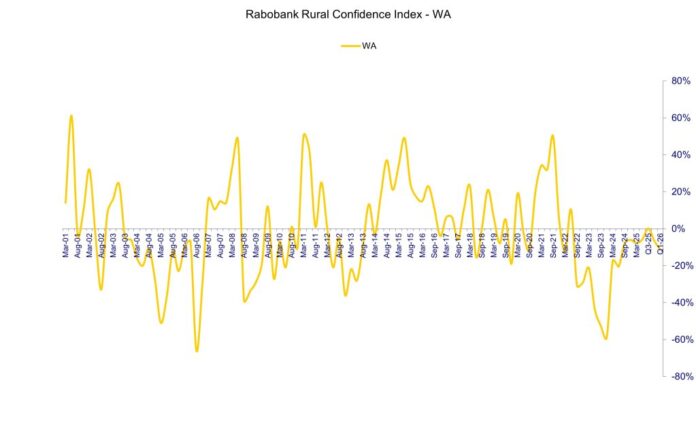
Western Australian farmers entered 2026 with subdued confidence levels, concerned about mounting cost pressures even prior to the current Middle East conflict.
The quarter one Rabobank Rural Confidence Survey found WA farmer sentiment had softened even before the start of the Iran War, with net rural confidence easing from -7 per cent in late 2025 to sit at -11 per cent.
Mounting cost pressures were already weighing on the sector as a key concern for the state’s farmers, along with government policy settings.
Rabobank WA state manager Steve Kelly said with the survey in the field prior to the current Middle East conflict, concerns about the cost and availability of farm inputs would now be figuring even higher in WA farmers’ minds, particularly leading into the winter cropping program.
“The uncertainty the conflict in the Middle East has created around price and availability of key agricultural inputs such as fuel and fertiliser is compounding WA farmers’ existing concerns about input costs, especially in the lead up to this year’s cropping program,” he said.
Mr Kelly said WA growers were particularly sensitive to global movements in energy and fertiliser markets given the state’s geographic isolation and dependence on imported inputs.
“Price volatility and high logistics costs mean some farmers may take a more conservative approach to input use, prioritising risk management and cash flow over production expansion,” he said.
While the quarter one survey, completed last month, had found the majority of WA farmers surveyed had started the year expecting conditions in the agricultural economy to remain stable over the next 12 months (at 56 per cent), fewer were expecting prospects would improve – 15 per cent (compared with 18 per cent last quarter). The portion who took a more bearish outlook on the year ahead sat at 26 per cent (up slightly from 25 per cent previously).
The softening in WA farmer sentiment in the survey had aligned with a decline in farmer confidence nationally.
In addition to higher input costs – which were a concern for 44 per cent of the state’s farmers in the survey – more than half reported they were worried about the impact to the agricultural economy from government interventions/policies (52 per cent, up from 45 per cent last survey).
Concerns about falling commodity prices had held steady – cited by 35 per cent of WA respondents – while drought worries had increased, with a quarter of WA farmers indicating they were expecting dry conditions to negatively impact the sector in the year ahead (up from 14 per cent last quarter).
Despite these pressures, 45 per cent of WA farmers were still expecting rising commodity prices to have a positive impact in the coming year (down from 57 per cent last survey), and 33 per cent anticipated a good season would benefit their business (up from 27 per cent).
Mr Kelly said the survey results had shown farmers were balancing the benefits of a record harvest with ongoing uncertainty around input costs, policy settings and market dynamics, including geopolitical risks, as they moved into the new year.
“High production last year has allowed many WA farmers to reduce debt levels, so they are coming into this year’s cropping program with strong balance sheets,” he said.
“However, they are dealing with tight margins and are cautious about how external factors – ranging from government decisions to global trade dynamics – which may impact their businesses.
The survey had found the WA grains industry to have entered the year with the lowest sentiment of all sectors in the state, with net confidence easing from -12 per cent to sit at -27 per cent.
“For grain growers, the record harvest didn’t automatically translate to higher confidence,” Mr Kelly said.
“Global pricing pressure and tight margins had also influenced sentiment. This is already flowing through to rotational decisions. The area of canola sown this year is forecast to expand in response to subdued cereal prices and to take advantage of subsoil moisture following good summer rain in some areas. With potential oil supply issues on the horizon, canola’s ties to ethanol production also support increased plantings.”
WA’s beef producers were also subdued in their outlook, with net confidence falling from 29 per cent last quarter to sit at -10 per cent in the Q1 survey. Beef producers were mainly concerned about the impact of government interventions/policies (60 per cent) and rising input costs (40 per cent).
Only 10 per cent of WA beef producers had nominated drought as a negative impact for the year ahead, reflecting widespread rain across much of the WA pastoral zone.
“The season has been strong for most beef-producing areas, with the exception of the Pilbara and Gascoyne regions. Combined with forecasts for continuing strong beef prices, there has been a strong start to the bull-selling season, which reflects confidence among producers to invest in genetics,” Mr Kelly said.
Sheep producers were the only sector in WA in the quarter one survey to record a rise in confidence, up to a net reading of nine per cent (was -3 per cent), on the back of ongoing strong prices.
“Lamb and mutton prices are expected to remain around current high prices for the foreseeable future, and wool prices are also holding steady which supports producers’ confidence,” Mr Kelly said.
He said the survey had also captured how WA sheep producers have refocused their businesses in response to the pending cessation of live sheep exports.
For the first time in three years, ‘threat to live export’ eased to single digits as a concern nominated by WA farmers, cited by only six per cent this survey.
“With just over two years to go until live sheep export is phased out, WA producers are focusing on transitioning their businesses,” Mr Kelly said.
As well as variation in confidence levels across the main commodities, sentiment had varied significantly across WA’s key agricultural regions in the survey.
Confidence was found to be highest – and stable – in the South West, where 73 per cent of farmers anticipated conditions would stay the same.
Central/Southern Wheatbelt farmers were more bearish in their outlook with 39 per cent expecting conditions to worsen, whereas sentiment in the Northern Wheatbelt had rebounded significantly in the survey with more than a third of farmers expecting conditions would continue to improve.
On the back of the record harvest, Mr Kelly said farmers had been active in paying down debt. However, caution about global price dynamics for key farm inputs and uncertainty about the grain price outlook had many reviewing their appetite for investment.
Fewer WA farmers in the survey indicated they would increase their investment over the next 12 months (23 per cent, down from 35 per cent last quarter), with a shift towards maintaining current levels (64 per cent, up from 54 per cent previously).
Farmers’ investment priorities for the year ahead included a growing interest in on-farm infrastructure (for 68 per cent, up from 63 per cent) and new plant and machinery (48 per cent, up from 45 per cent).
“Conversations around potential fuel shortages could translate into investment in more on-farm fuel storage as a risk management strategy in the future,” Mr Kelly said.
There was reduced intention to invest in new technologies (32 per cent, was 45 per cent), but more WA farmers indicated they intended to increase livestock numbers (27 per cent, 23 per cent).
There was also stronger interest in purchasing more farmland expressed in the survey, with 18 per cent of WA farmers keeping an eye out for expansion opportunities, up from 14 per cent last quarter.
“Although high input costs are tempering optimism for the year ahead, WA farmers continue to create on-farm efficiencies through strategic growth,” Mr Kelly said.
A comprehensive monitor of outlook and sentiment in Australian rural industries, the Rabobank Rural Confidence Survey questions an average of 700 primary producers across a wide range of commodities and geographical areas throughout Australia on a quarterly basis.
The most robust study of its type in Australia, the Rabobank Rural Confidence Survey has been conducted since 2000 by an independent research organisation. The next results are scheduled for release in June 2026.
This press release has also been published on VRITIMES