



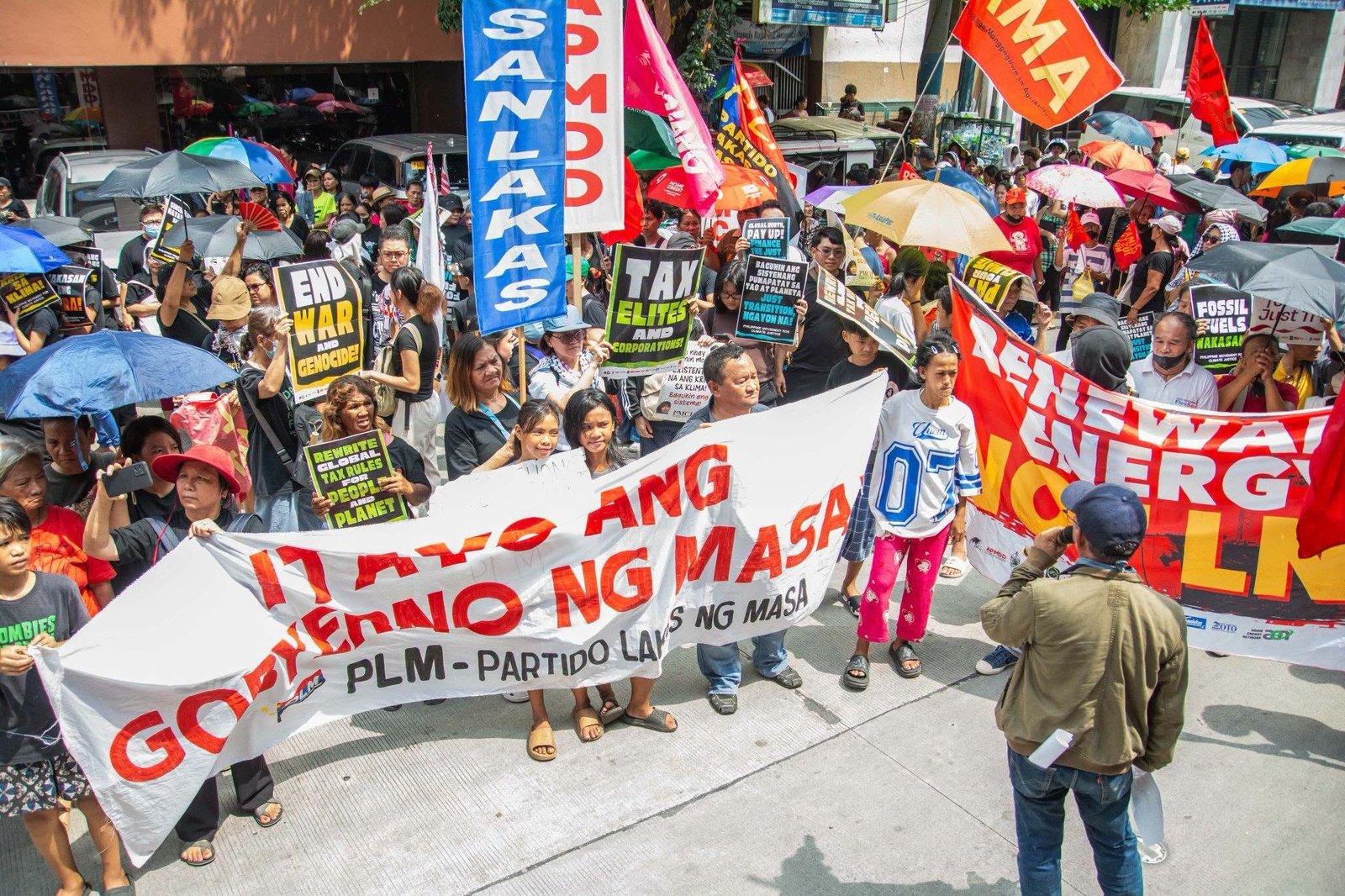
Filipino activists and urban poor residents marched from Liwasang Bonifacio to the U.S. Embassy on Sept. 18, 2026 to demand a global phaseout of fossil fuels, as part of the Global Week of Action for a Fossil-Free Future coinciding with the 81st session of the United Nations General Assembly.
The Manila demonstration was part of Asia-wide actions organized by the Asian Peoples’ Movement on Debt and Development. The group said similar mobilizations were held in Bangladesh, Pakistan, India, Nepal and Indonesia.
Organizers said the protest highlighted the Philippines’ vulnerability to intensifying climate impacts following recent floods in Central Luzon and a new U.N. Environment Programme report that found the world is on track to cross 1.5 degrees Celsius of warming.
Protesters called for climate reparations and for the United States, the world’s leading producer of oil and gas and largest historical polluter, to lead a fast, fair and funded phaseout and provide transition finance for developing countries.
The week of action comes amid a global fuel crisis triggered by the ongoing war in Iran, which organizers said has underscored Asia’s dependence on imported fossil fuels.
“We have no choice but to dismantle the fossil fuel dependence that has chained Asia’s economies to the extraction, production, and consumption of coal, oil, and gas,” said Lidy Nacpil, coordinator of APMDD.
Nacpil said governments meeting in New York for the U.N. General Assembly have an opportunity to strengthen cooperation to “end import-dependent, costly, harmful, and volatile fossil fuel energy systems and replace them with democratic renewable energy systems.”
Ian Rivera, national coordinator of the Philippine Movement for Climate Justice, said the U.S. and other wealthy nations have profited from fossil fuels while exporting impacts to the Global South.
“The climate crisis did not emerge from nowhere — it was engineered by the world’s most powerful economies, spearheaded by the United States and its allies,” Rivera said. He called for a halt to new fossil fuel projects, a shutdown of existing oil, coal and gas infrastructure, and a transition to 100% renewable energy funded by polluting governments.
Labor leader Luke Espiritu, president of Bukluran ng Manggagawang Pilipino, said crossing the 1.5-degree threshold will be deadly for workers in developing countries.
“The Filipino people are being forced to pay for a crisis we did not cause, draining our financial resources and diverting public funds away from social services,” Espiritu said.
Organizers also cited the International Court of Justice’s 2025 advisory opinion on climate change, which was adopted by the U.N. General Assembly in May. The opinion found that states have a legally binding obligation to prevent climate change and that granting new fossil fuel licenses, providing subsidies and failing to regulate emissions can be considered internationally wrongful acts requiring reparations.
“Governments at the UNGA voted to operationalize the ICJ advisory opinion last May, and now they must turn the resolution into action,” Nacpil said.
APMDD said climate reparations should be funded through tax justice measures, including a U.N. framework convention on international tax cooperation, fossil fuel surtaxes and wealth and windfall profit taxes.
Photo by Thomas Brecio and Riz Ornada