



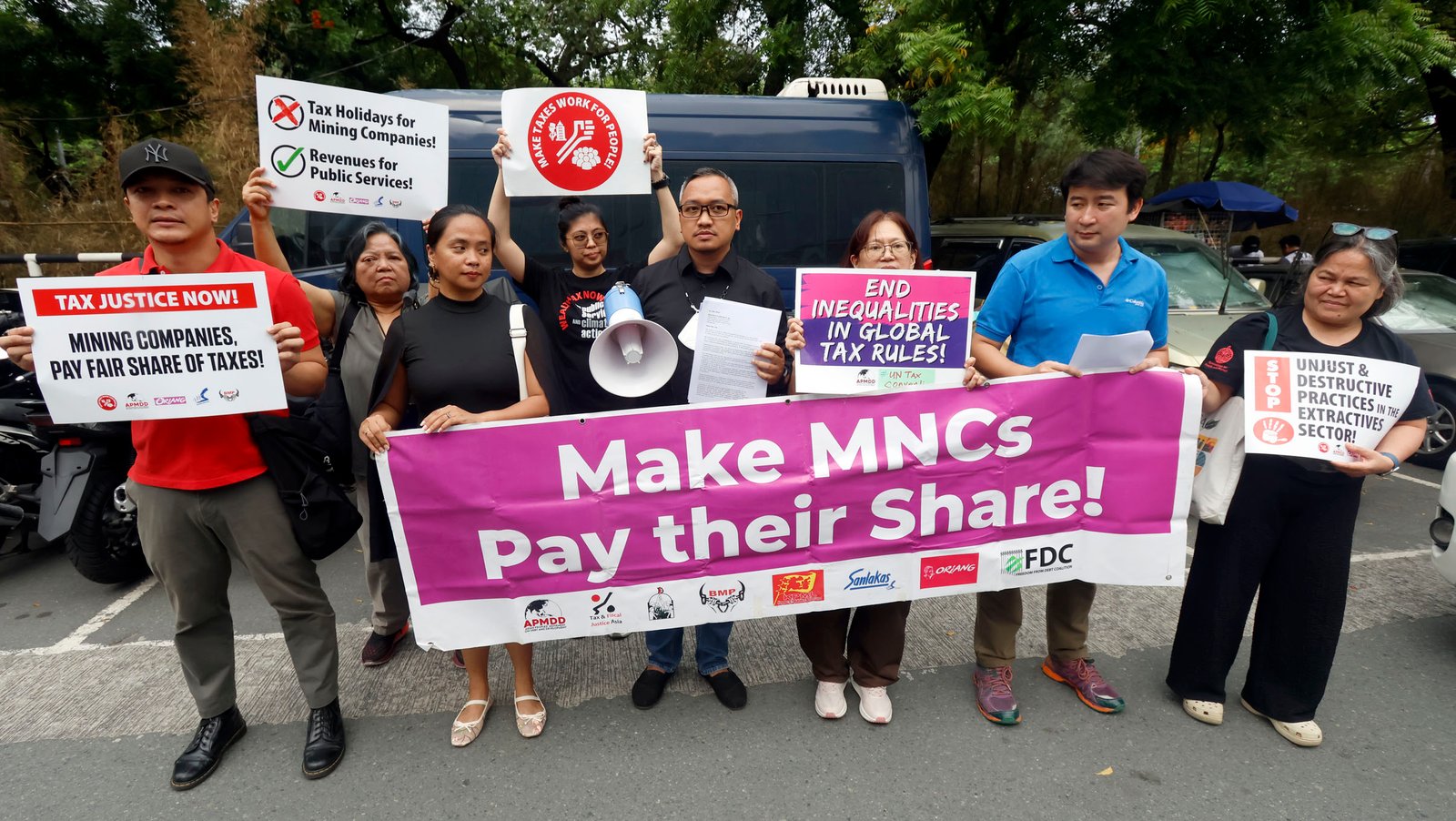
MANILA–Labor and civil society organizations on Tuesday called on Finance Secretary Frederick D. Go to take a stronger pro-people stance in United Nations tax negotiations by pushing for taxes on the super-rich and on multinational extractive corporations.
Workers led by the Bukluran ng Manggagawang Pilipino, or BMP, and Sanlakas gathered in front of the Department of Finance headquarters on Roxas Boulevard from 9 a.m. to 10 a.m.
The action was organized with the Asian Peoples’ Movement on Debt and Development. BMP president Luke Espiritu and Sanlakas president Aaron Pedrosa spoke at the rally.
The groups said Go must use the Philippines’ seat at the U.N. to demand a global tax system that taxes wealth and stops profit-shifting by extractive multinationals.
The Philippines was among the majority of U.N. member states that voted in November 2023 to create a United Nations Framework Convention on International Tax Cooperation. It also voted for the convention’s terms of reference, which mandates the creation of an inclusive, fair, transparent and equitable international tax system for sustainable development.
Organizers said global tax rules are still written by the Organization for Economic Cooperation and Development, the Group of Seven and the Group of 20 — institutions where developing countries have little say and whose policies favor wealthy nations and their corporations.
That model has allowed billionaires to amass untaxed wealth and extractive firms to siphon profits from countries like the Philippines while leaving behind environmental destruction and underpaid labor, the groups said.
“Tax justice cannot happen if the rules continue to be set by the rich for the rich,” the groups said in a statement ahead of the protest.
They said the Department of Finance should ensure that the final U.N. convention includes binding commitments on wealth taxation and on the equitable taxation of multinational enterprises, especially in mining, oil and gas.
The protesters said revenues from such measures could fund higher wages, public health, education and climate resilience instead of relying on regressive taxes and borrowing that burden ordinary Filipinos. (Photo: Mata: Asia Press Photo)