
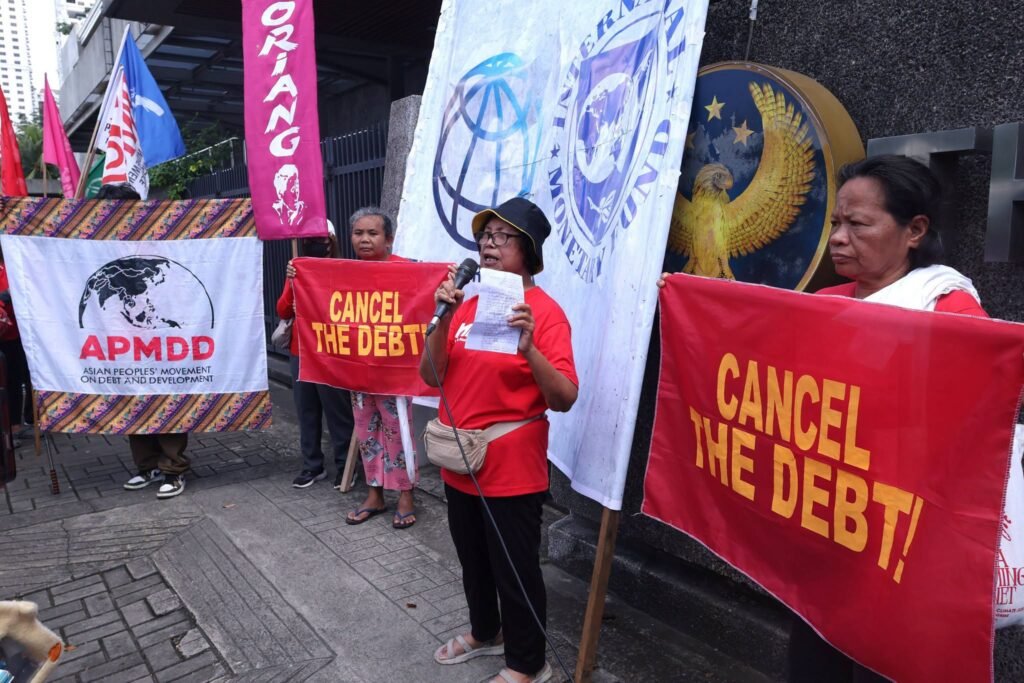
MANILA, Philippines–Around 500 activists marched Friday to the International Monetary Fund office inside the Bangko Sentral ng Pilipinas complex in Manila to protest what they described as decades of debt, poverty and climate injustice tied to the IMF and World Bank.
The demonstration was organized by the Asian Peoples’ Movement on Debt and Development (APMDD) as part of a Global Day of Action targeting the two institutions. According to organizers, similar actions were held in Asia, Africa, Europe and Latin America coinciding with the annual meetings of the IMF and World Bank in Bangkok, Thailand, where finance ministers and central bank governors gathered.
Protesters accused the IMF and World Bank – known as the Bretton Woods institutions – of fueling 80 years of structural inequality, ecological damage and human rights violations through predatory lending, resource extraction, unequal trade rules and neocolonial dependence.
Organizers said debt-distressed countries are forced to cut budgets for health, education and climate resilience while funds continue to flow toward arms production and nuclear modernization.
“For over 80 years, the IMF and World Bank have pushed policies and agendas that concentrate wealth and power in the hands of Global North countries and their elites,” said Lidy Nacpil, coordinator of APMDD. “They control an international financial architecture that drives global inequality and climate catastrophe.”
The coalition called for a structural overhaul of the global financial system, including the cancellation of unsustainable and illegitimate debts, an end to IMF surcharges and austerity conditions, and reparations for historical injustices.
Local climate and labor groups tied the issue to conditions in the Philippines.
Ian Rivera, national coordinator of the Philippine Movement for Climate Justice, said World Bank financing had supported coal-fired power plants that harmed host communities – a concern he said was flagged even by the compliance ombudsman of the International Finance Corporation, the World Bank’s private sector arm.
“We must phase out these remaining coal plants immediately,” Rivera said.
Luke Espiritu, president of Bukluran ng Manggagawang Pilipino (BMP), said privatization policies backed by the IMF and World Bank helped push Philippine electricity rates to among the highest in Southeast Asia.
“The privatization of public services has caused serious economic harm to Filipinos,” Espiritu said. “If the World Bank and the IMF are serious about helping developing countries, they must cancel the debts.”
Photo: Elmer Valenzuela/Mata: Asia Press Photo