
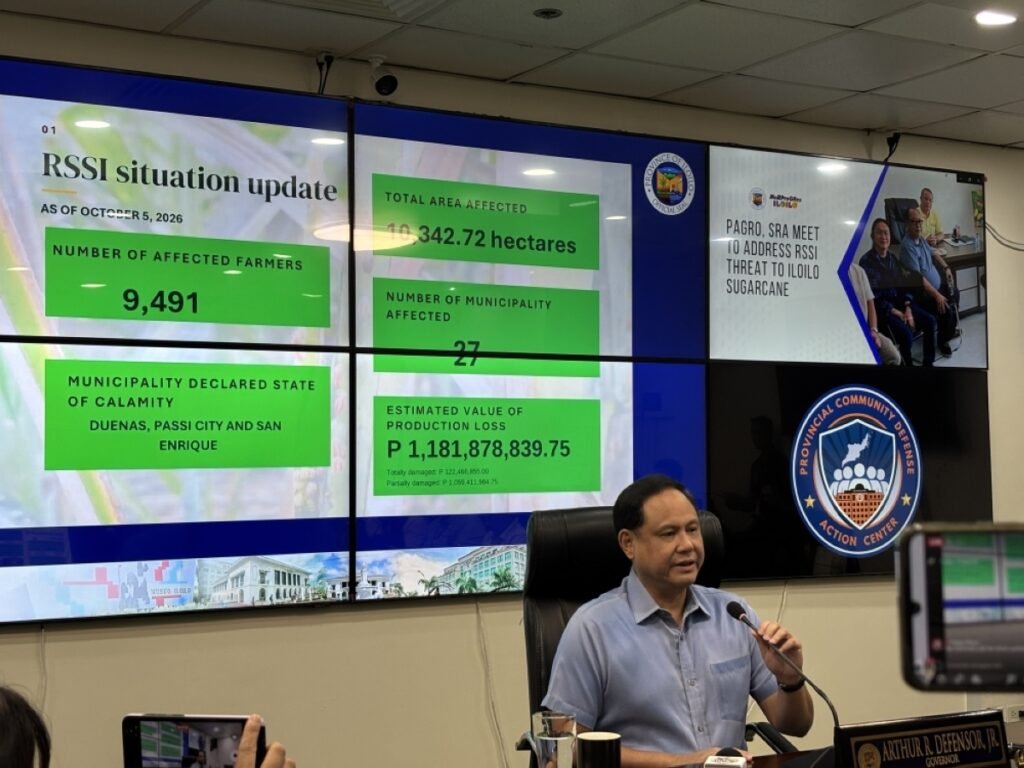
Iloilo province is grappling with considerable agricultural setbacks declared at approximately P1.18 billion as a result of the rampant infestation of the red-striped soft scale insect (RSSI). Recent data from the provincial government indicates that as of October 5, total production losses consist of P122.5 million due to completely damaged crops and about P1.06 billion from partially damaged crops, impacting local farmers profoundly.
At least 27 out of the 43 local government units in Iloilo have reported cases of RSSI, which has invaded 10,342.72 hectares of land, affecting some 9,491 farmers. The alarming spread of this pest has prompted three municipalities—Passi City, San Enrique, and Dueñas—to officially declare a state of calamity due to the escalating damage.
Governor Arthur Defensor Jr. is contemplating a wider declaration of a state of calamity across the province, citing a drastic increase in the affected area from around 7,000 hectares two months ago to well over 10,000 hectares now. The governor emphasized the government's need to establish effective protocols and assess the province's capacity to manage the crisis as the situation evolves.
Alongside government aid, the provincial authorities are intensifying efforts to implement biological control strategies to mitigate the spread of RSSI, although these measures have not yet proven fully effective in combating the infestation. Governor Defensor mentioned that while pest activity often declines during rainy seasons, it resurges strongly in hotter periods, marking it as a persistent issue comparable to the ongoing struggles with African swine fever in the region.
The implications of this infestation stretch beyond crops alone, as the Department of Social Welfare and Development (DSWD) reported that over 36,000 families in 498 barangays across Iloilo, Capiz, and Passi City have been adversely affected. Among affected families, Capiz is witnessing the most significant impact, with nearly 18,719 families losing their livelihoods, followed closely by Iloilo with 16,642 families.
As the crisis unfolds, Passi City has emerged as one of the hardest-hit areas, with the mayor announcing that around 7,000 sugarcane planters and workers are suffering from the impact of RSSI. The pest's reach has expanded to nearly all but two of the city’s 51 barangays, exemplifying the outbreak's rapid progression and its serious ramifications for local agriculture.
In a bid to support the affected farmers, DSWD Secretary Rex Gatchalian visited Passi City on October 5 to oversee the distribution of emergency cash assistance. Each beneficiary, primarily sugarcane farmers, received P10,325. The initiative aims to help around 6,000 farmers, with initial assistance provided to 1,163 individuals, addressing those most severely impacted first. Gatchalian reiterates the government’s commitment to continue monitoring and supporting the needs of local farmers.
Meanwhile, in Capiz, the DSWD rolled out over P105 million in emergency cash assistance aimed at sugarcane farmers and plantation workers affected by RSSI in late September. This financial aid targeted over 9,800 beneficiaries from various municipalities, demonstrating coordinated efforts to alleviate the plight of those governing their circumstances amid this agricultural emergency.
The Capiz Provincial Council reacted promptly to the threat by declaring a state of calamity as early as August 10, seeking to mobilize resources and implement strategies to counteract the pest's damage.